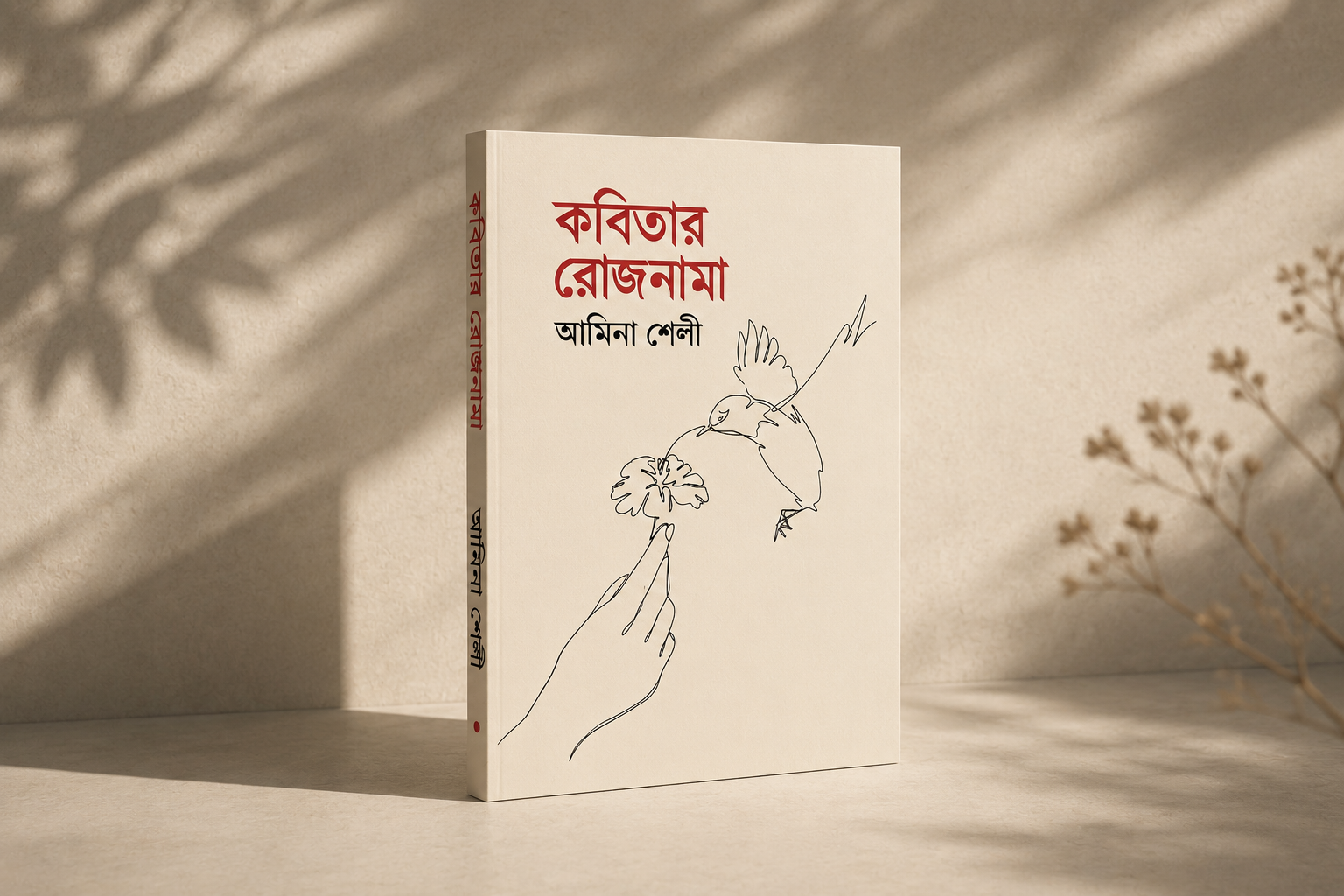
Kobitar Rojnama (A Diary of Poetry)
Amina Shelly
Poetry · Autobiographical · Bangla
Poetry is where life is felt.
At a Glance
Kobitar Rojonama is, at its heart, is an extended poetic experience of reading life as poetry.
About the Book
Where does poetry really live?
In a few lines written on paper? Or in the small moments of everyday life? Moments we are often too busy living to recognise as poetry?
As the title suggests, Kobitar Rojonama—A Diary of Poetry—keeps a diary of life through poems.
Here, poetry is a paper cone of bheter khoi roasted in an earthen pot. A piece of ghee-chamcham given by a travelling vendor in exchange for old bottles. A muli bamboo bridge over a river. The silk mosque on her mother’s prayer mat. Sweat on a day labourer’s gamcha. Poetry is also a lover’s touch. A mother’s eyes. Leaving one’s homeland. Poverty. A woman’s sighs.
Much of the book belongs to rural Bengal. Ponds, haors, paddy fields, earthen roads, tin-roofed houses and bamboo footbridges. Shital pati, nakshi kantha, lanterns and earthen water pots. Through these everyday things, the poems return to a way of life that is slowly disappearing. But this is not a picturesque village seen from a distance. The poet belongs to this life. So alongside nature there is hardship and labour. Social inequality. Women’s lives. Migration. A changing time.
Memory is another part of the book. A grandmother tracing Nagri letters on the earth. A boat journey to Goalabazar with her father. A three-minute telephone conversation with her father living abroad. Through these small memories we see another time. The village changes too. It is no longer simply a place on a map. It becomes roots. Identity. A way of returning to oneself.
Beyond personal memory, history and the contemporary world also enter the book. Other lives begin to stand beside the poet’s own. At times, the poems move from the personal into the wider world. And through all of this, one question keeps returning—what is poetry?
The book does not look for a single answer. Poetry can be memory. The body. Hunger, protest or love. A moment in life that touches us deeply can become poetry too. Kobitar Rojonama is essentially a search for those moments.
Author's Note
Every book has its story. This book's story is fascinating. I will tell you quietly, another day or, it will become another manuscript. For now a little about the poems in this poem—
There are 69 poems here, 68 of which I wrote in 4 days in the new year holidays of 2025. A sudden thought came—what is poetry? I didn't look for the answer in a dictionary. I looked within me. To me, poetry isn't confined to a particular subject, language or moment—it is the life I have lived in whole.
The village of my childhood. Earthen roads. Ponds, haors and paddy fields. My mother’s face. Boat rides with my father. My grandmother’s hands. Hardship, joy, love, separation. At one time or another, all of these have become poetry to me. I left that life behind. From a distance, I realised how deeply it had stayed with me.
When I wrote the poems in this book, I wasn't trying to define poetry. I simply wanted to find out where it had been hiding in my own life. Sometimes I found it in things unspoken of. Sometimes in a memory that meant little to me at the time. Years later, that same memory returned as poetry.
Kobitar Rojonama is a record of certain times in life—of things seen and unseen, found and lost, and those that stayed with me
— Amina Shelly
Book Details
Title: Kobitar Rojonama
Author: Amina Shelly
Genre: Poetry · Autobiographical
Language: Bangla
Poems: 69
Pages: 80
Binding: Hardcover
Edition: First Edition
Publication Date: August 2026
Publisher: Avro Prakashan
Cover Design: Advik Shelly
ISBN: 978-984-29704-1-2
Price: BDT 280
Get the Book